21 Oct 2025
5 Min Read
The AI Guardian: How Real-Time Pattern Detection Can Revolutionize Fair Play in Gaming
There is no greater frustration for an online gamer than getting into a competitive match only to have the experience ruined by a cheater. That perfect headshot from an impossible angle, the opponent who always seems to know where you are—it breaks the trust and fun that are the very foundation of competitive play.
For years, the anti-cheat industry has fought this battle with one hand tied behind its back. Traditional systems work like detectives, arriving at the scene of the crime hours later to analyze the evidence. They run batch jobs on completed match data, find statistical anomalies, and eventually, ban the offending account. But by then, the damage is done. The cheater has already ruined the experience for dozens, if not hundreds, of legitimate players.
This is forensic justice. What the gaming community needs is preventative justice.
What if we could detect a cheater not hours later, but seconds after they toggled their cheat on? What if we could neutralize the threat before they could even ruin a single round? This isn't a futuristic dream; it's a new reality being built with real-time data and AI.
Hunting for Ghosts in the Machine: Beyond Statistics to Patterns
The weakness of traditional systems is that they look at the outcome (e.g., a 95% headshot rate over a 20-minute game). A truly modern approach looks at the behavior that leads to that outcome.
A classic aimbot, for instance, exhibits a very specific, inhuman sequence of actions:
- A player is aiming normally.
- An enemy appears on screen.
- The player's crosshair instantly snaps to the enemy's head in less than 20 milliseconds—a reaction time physically impossible for a human.
- A shot is fired, resulting in a perfect kill.
This sequence—this pattern—is the cheater's signature. And with modern streaming data platforms, we can now hunt for this signature in real time. Using a powerful streaming SQL feature called MATCH_RECOGNIZE, we can define this exact "Snap-to-Target" pattern and apply it to the firehose of player actions coming from the game servers. It acts like a highly specialized net, ignoring all legitimate plays but instantly catching the specific, ordered sequence of events that gives a cheater away.
Context is King: The Difference Between a Pro and a Cheat
But how do you avoid false positives? What if a professional player, with thousands of hours of training, has an incredibly fast reaction time?
This is where simple pattern matching evolves into intelligent detection. The key is to enrich the live action data with historical context, which is where a temporal join becomes critical. For every single action a player makes, our system performs an instantaneous lookup against their historical performance record. The MATCH_RECOGNIZE query becomes much smarter. It's no longer just looking for a fast reaction time; it's looking for a player with a history of 15% accuracy who is suddenly playing with 95% accuracy and inhuman reflexes. It's this discrepancy between established history and current action that provides the high-confidence signal we need.
The Guardian AI: From Real-Time Detection to Intelligent Action
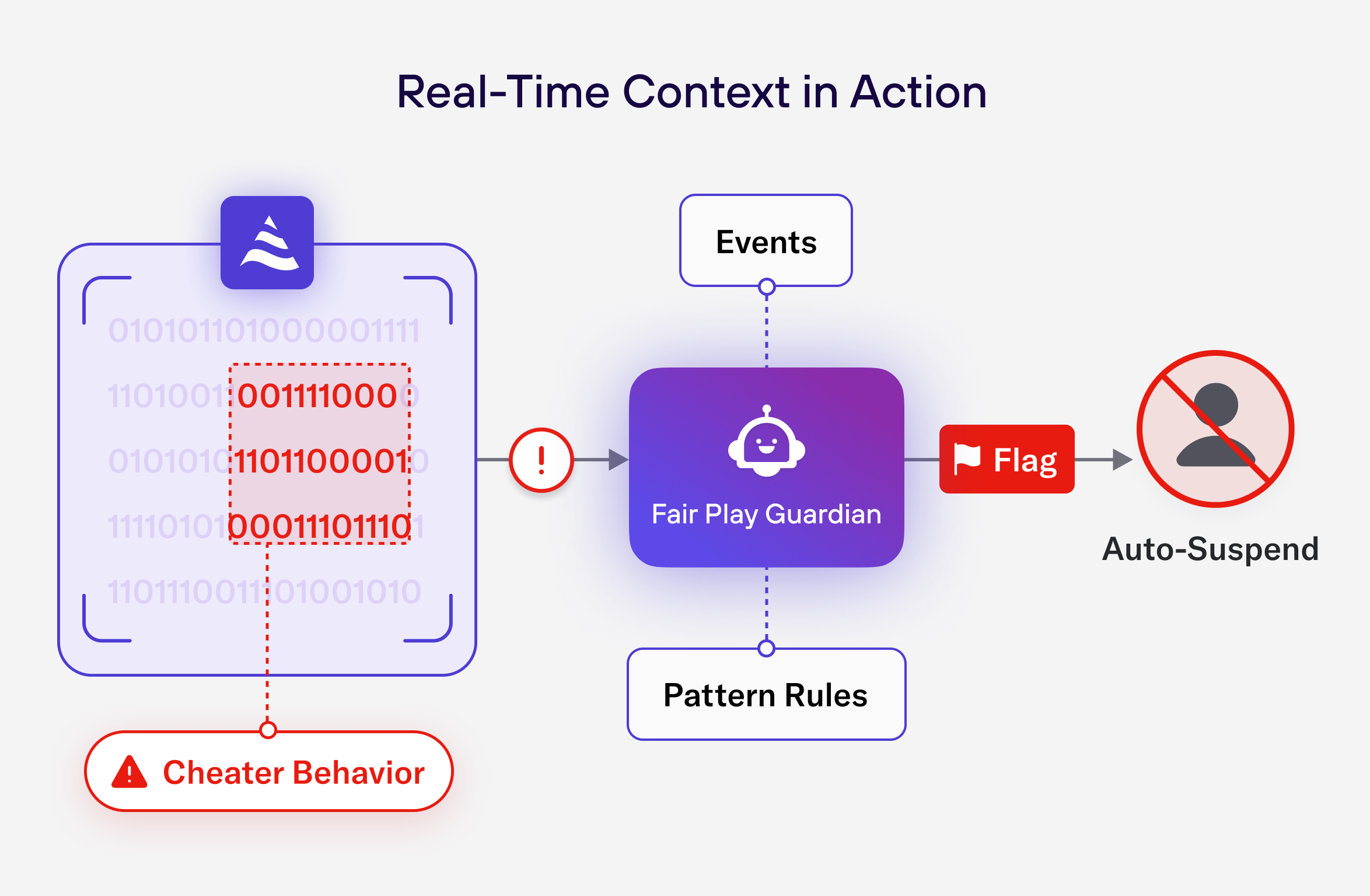
Detecting the cheat is only half the battle. The final piece of the puzzle is taking immediate, intelligent action. This is the role of our "Fair Play Guardian," a GenAI agent designed for real-time match moderation.
Here's how it works:
- Detection: The
MATCH_RECOGNIZEquery in DeltaStream detects a high-confidence cheat pattern from a player. It instantly creates an entry in a materialized view—a real-time alert. - Trigger: This alert triggers the Fair Play Guardian agent.
- Context: The agent's first step is to query the materialized view to get the full context: the player's ID, the inhuman reaction time, their historical stats, and the timestamp of the event.
- Action: Armed with this evidence, the agent takes proportional action. It doesn't issue a premature, automated ban. Instead, it uses a game server API to seamlessly move the cheater into an isolated "shadow lobby" at the end of the current round. The cheater is neutralized, the match is saved for the other 9 players, and the full evidence package is escalated to a human moderator for a final decision on a permanent ban.
The Future of Fair Play is Instantaneous
This closed-loop system—from real-time pattern detection to AI-driven action—closes the gap from hours to seconds. It represents a fundamental shift from reactive punishment to proactive protection.
Building a system like this from the ground up is a monumental task. However, modern real-time data platforms with streaming SQL capabilities, including powerful functions like MATCH_RECOGNIZE and temporal joins, are making this level of sophistication accessible. They provide the engine to turn raw event streams into the intelligent, real-time context that AI agents need to operate effectively, ensuring that the future of competitive gaming is, above all, fair.
You can find the full implementation of this use case at DeltaStream’s examples repository here:
https://github.com/deltastreaminc/examples/tree/main/FairPlayInGaming
This blog was written by the author with assistance from AI to help with outlining, drafting, or editing.