09 Nov 2026
7 Min Read
Autonomous real-time agents: the category AI has been waiting for
Most of the conversation about AI agents today is about agents that help people. They answer questions, write code, draft emails and summarize meetings. They're useful, and they share one trait: they wait for someone to ask.
There's another category of agent that hasn't had its moment yet: the autonomous real-time agent. It doesn't wait for a prompt. It watches what's happening across a business as it happens, decides when something matters, and acts on its own within seconds. I believe this will become one of the most valuable ways companies use AI, and I want to explain why it has been so slow to arrive and why that's about to change.
What makes an agent real-time
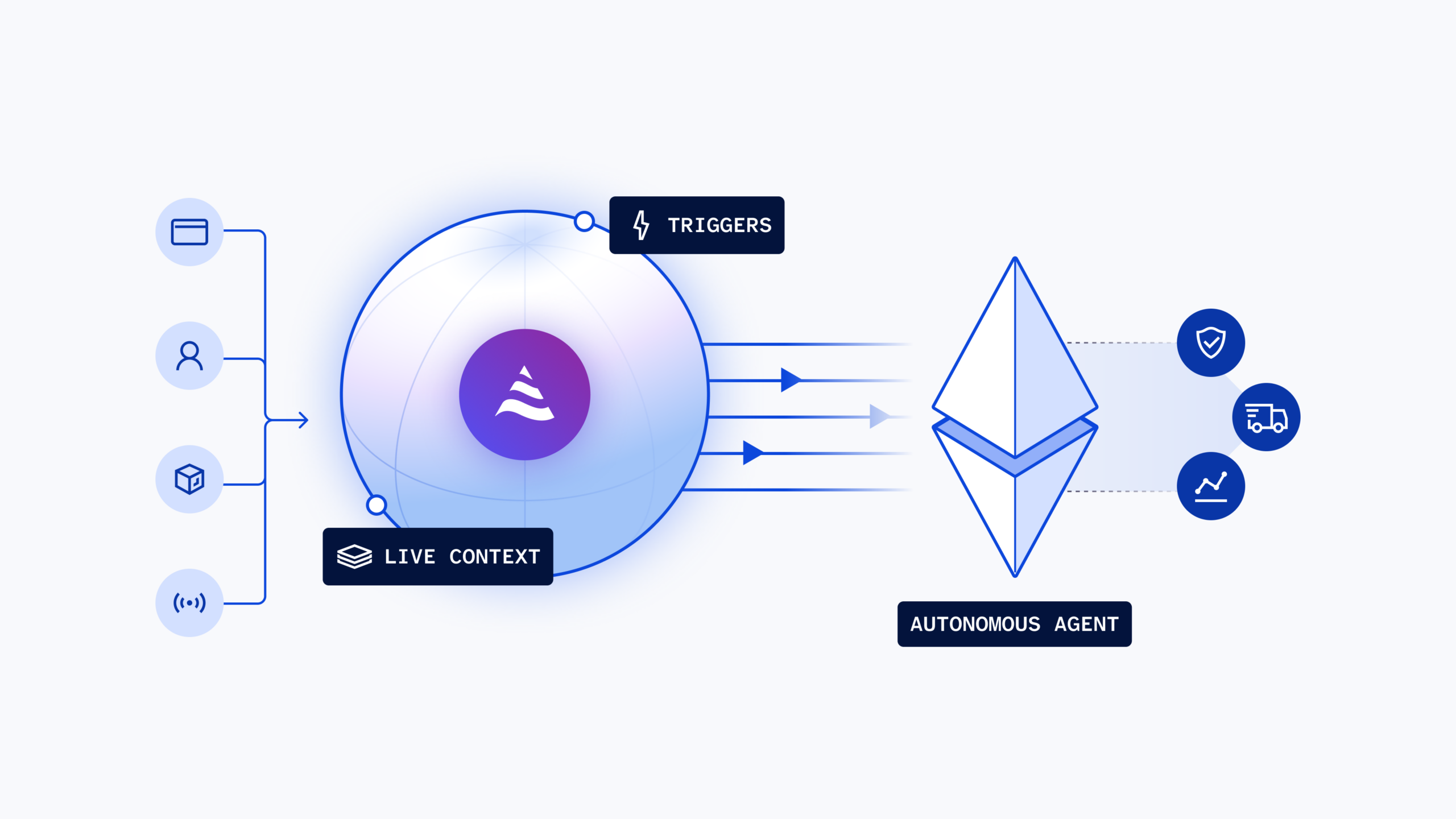
A real-time autonomous agent needs two things most agents never had to think about.
The first is live context: an accurate picture of what is true right now. Not as of last night's batch job, and not as of the last time someone refreshed a dashboard. An agent deciding whether to block a payment needs the customer's last ten transactions, including the one from forty seconds ago.
The second is triggers: the event that wakes the agent up the moment it needs to act. A chatbot is triggered by a person typing. A real-time agent is triggered by the world: a payment, a sensor reading, a login from an unusual place. Some of the most important triggers are about something that didn't happen, like an order with no payment confirmation ten minutes later.
Without live context, the agent is guessing. Without triggers, it's late. With both, you get something genuinely new: software that notices what matters and acts on it while it still matters.
Every industry has these moments
Once you start looking, moments where late is the same as never are everywhere. In financial services, it's the fraudulent payment that settles before anyone looks at it. In e-commerce, it's the customer who gives up on a broken checkout, or a pricing error that sells inventory at a loss for an hour. In logistics, it's the shipment that slips past the window where it could still be rerouted. In manufacturing and IoT, it's the machine drifting toward failure while the maintenance report runs nightly. In cybersecurity, it's an attacker moving from one system to the next while every log says the access was authorized. Telecom, energy, healthcare and gaming tell different stories with the same shape.
Today most of these moments are handled by a dashboard someone checks, an alert someone triages, or a report someone reads the next morning. An autonomous real-time agent closes that gap. It acts within seconds, under rules your team sets, and explains what it did and why.
Why this category hasn't matured
If these agents are so valuable, why aren't they everywhere? Because the hard part was never the agent. It was everything underneath it.
Large language models made reasoning and acting cheap. They did nothing for live context and triggers. Building those takes streaming infrastructure: joining live event streams, keeping state that spans days or weeks for every customer or device, handling event time and late data correctly, noticing when something expected never arrived, and keeping all of it running when something breaks at 3 a.m. That has traditionally meant Kafka, Flink and a team of specialists who know them well.
Even with that team, a single use case takes weeks to build and months to harden. Most companies don't have the team. So the agent gets scoped down to something that runs on yesterday's data, or it never gets built at all. That's the real reason this category has stayed immature. It was never a lack of ideas or models. It was the cost of giving an agent eyes on the present.
DeltaStream takes the hard part away
DeltaStream is the platform for building and running real-time agents, and the builder is usually not a person. It's a coding agent.
DeltaStream exposes the whole platform through an MCP server. Claude or any other coding agent connects to it, explores your streams, writes and runs the streaming SQL, builds the live views an agent queries for context, and sets up the triggers that wake it up. Our documentation and reference templates are available to the coding agent over the same connection, so it looks up how to do something correctly instead of guessing. Everything runs on DeltaStream as a fully managed service, so there is no cluster for anyone to operate.v
In practice, the people building real-time agents on DeltaStream rarely touch DeltaStream at all. They describe the agent they want: what to watch, when to act, what it's allowed to do. Their coding agent builds the pipelines, the live context, the triggers and the agent itself, deploys everything, and keeps it in version control, where the team reviews it like any other code. Nobody writes a line of code by hand, and nobody has to become a streaming expert.
That changes the economics of the whole category. Specialized work that used to take a team weeks or months now takes a coding agent hours, and the result runs on infrastructure built for exactly this job.
One example, built in hours
To show what this looks like end to end, we built Double Agent, a real-time agent that catches AI tools that misbehave. Companies give their agents access to email, documents and business systems through tools they didn't write. If one of those tools is compromised, every log still says the access was authorized. Double Agent compares what each agent asked its tools to do with what actually happened, and when something happens that no agent asked for, it contains the incident and hands it to a responder agent to investigate.
I started with an empty DeltaStream workspace and a short brief, and prompted Claude through the whole thing: the streaming pipeline, the live context, the responder agent on Claude Managed Agents, the containment service on Render, all of it versioned in GitHub. It went from nothing to a deployed, working system in hours. Not long ago, that would have been a quarter on a streaming team's roadmap.
You can watch the full build in the video with this post. The use case matters less than the pattern: live context, a trigger, and an agent that acts. That pattern fits fraud, operations, logistics, IoT, customer experience, and almost anywhere timing matters.
The door is open
When something becomes dramatically cheaper and faster to build, you don't just get more of the same. You get things nobody bothered to build before. That's what I expect to happen with autonomous real-time agents. The question in every company stops being "can we afford a streaming team for this?" and becomes "which moments in our business should have an agent watching them?"
The companies that get the most out of AI over the next few years won't necessarily be the ones with the biggest data engineering teams. They'll be the ones that turn real-time signals into action fastest. With a coding agent building on DeltaStream, going from idea to a running real-time agent now takes hours, not weeks or months.
If there's a moment in your business where acting late costs you, we want to build that agent with you. We're launching the DeltaStream Design Partnership program for real-time agents, and your first agent is on us. Go to deltastream.io to join, and let's put autonomous real-time agents to work in your organization.